Posted on December 15, 2021 by admin
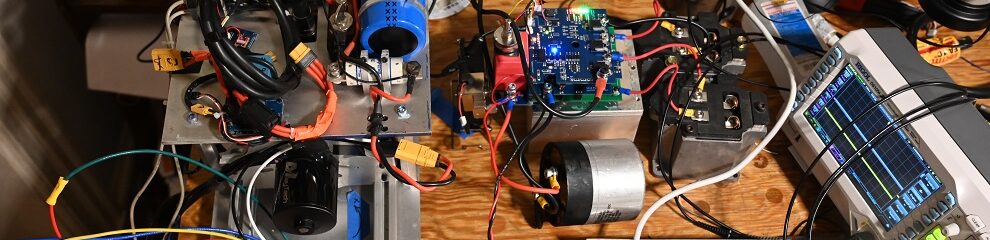
The good ole’ 2nd gen Prius boost inductor. Extra large, extra cheap. I was unable to find a measurement of the saturation current of this inductor on the internet, so I set out to measure it myself. This inductor is one of the beefiest I’ve ever set my eyes upon, at about 400uH, and I estimated it had a saturation current somewhere between 150 and 200 amps. I measured the line-to-line resistance at 19 milliohms. At 150 amps, this equates to over 400W of resistive losses alone. I plan on using this inductor for the big dyno, where it will
Posted on December 9, 2021 by admin
The land of motor ratings is pretty dubious. All too often, people say, “yes, this motor has a stall torque of 11.8 Nm and a no-load speed of 16krpm- therefore this motor produces TWENTY THOUSAND WATTS.” Alright then… But did you actually measure that? How do we even measure power of a motor in the first place? What even is power? Let’s get into the physics… An electric motor is a device which converts electrical power into mechanical power, usually through a magnetic field. The same device is also a generator, when the flow of power is reversed and the
Posted on October 31, 2021 by admin
The successor to the small dyno: the big dyno. This dyno should be good for around 30 Nm continuous up to 8-10K RPM, and then around 20-30kW from there. It is a lot of dyno.. should be excellent. This size of dyno was inspired by Ben and Bayley’s big dyno. Finding myself in need of a more powerful dyno to test ever larger motors, it was time to build my own. Here is the CAD as it stands. The dyno is largely based around an altermotter paired with an HBM 100Nm 20,000 RPM digital output torque sensor. Interestingly enough, the
Posted on October 9, 2021 by admin
Over the past four years, automotive hybrid air conditioners have been a wonderful source for rotors and stators. All the automotive components are automotive quality, yet purchasable at junkyard prices. So far, all the air conditioners we’ve dissasembled have been of the IPM variety. We’re not exactly sure why, but we believe this is because the magnets can be straight instead of curved, reducing magnet costs. Additionally, the rotor can be constructed using less magnet per unit torque, again reducing cost. Either way, IPMs are cool, so let’s get started. So far, I’ve disassembled four different air conditioner units, all
Posted on December 2, 2020 by admin
Today I laid out a board in record time: 2.5 hours! And, its even a motor drive! However, I did cheat a bit and use a daughter board. My work was throwing out several DRV8305 evaluation boards, which are more or less the same as the lovely DRV8323RS TI motor driver we’ve all come to love. The “throwing out several” part is important, because if I blow up the power stage, I can simply swap my daughter board with minimal effort.. The evaluation board in question: My daughter board design: At the heart of the design is the new STM32G431
Posted on November 30, 2020 by admin
Not much in this post, but its definitely worth mentioning if any readers care to make dollys for their machine tools. A core tenet of the austinshop final plan is to have the surface grinder on wheels such that it can be wheeled outside to use, to protect the shop from being covered in grinding dust. To do this I need some way of wheeling it. And the surface grinder isn’t light, so it needs to be extremely strong. I started with the door bits because they are nice, strong wood about the right size (read later post to see
Posted on November 30, 2020 by admin
A post which is kind of a cop-out because I wasn’t the one who put in the effort, but it’s worth mentioning. The tarp mentioned in part 2 was not a permanent solution. A more permanent solution can be purchased with money: having some dudes come over and re-shingle the roof. We got a few quotes and went with the best one. The dudes showed up right after a huge snow, so the first step was shoveling the garage. Then they got to work. It was pretty insane watching them go- these guys were roofing machines. One kind of interesting
Posted on November 30, 2020 by admin
FINALLY- the big day. October 10th, 2020. The day where I increase the weight of my personal possessions by approximately 5000 lbs. Nothing like moving nearly 40 times your body mass. Let’s back up one day though to the day before though, to October 9th, where I did some pre-move moving. I cleaned up a bit around the various tools, mostly around the Hardinge. The drawers on the Hardinge were the ‘summer set’ of drawers, as in, the wooden drawers had expanded and completely jammed about 6 inches open. By aggressively rocking the drawers from side to side and up/down,
Posted on November 29, 2020 by admin
Not too much of a post here, but worth noting. This post will not adequately convey the amount of effort put into the events covered, the ratio of effort to post length here is quite high. So, the garage. When I moved in, I noticed that there was a broken rafter. Huh, interesting. We added a temporary stick brace. Just out of curiosity, I decided to read up on rafter spacing building codes. It seems like most places have 12, 16, or 24″ rafter spacing, and mostly 2x6s because New England. I decided to measure the garage for kicks. The
Posted on November 17, 2020 by admin
How to vaguely guess the approximate ballpark size of moter required for your application. These are all ballpark numbers, but generally a good starting point for your average motor. Two important parameters: torque and speed. Lets start with speed. This is the easy one: For small inrunners (4″ OD or less), max speed is somewhere around 12k-16k RPM. For Hobbyking inrunners it depends on the quality of construction. For some motors, the magnets will fly off the rotor at high speeds, so probably no not exceed 15k rpm. If the rotor has a carbon or kevlar overwrap (or is an